Stories that are incredibly different, out there in so many ways, have a real hit-or-miss quality, unfortunately. Well-written, clever-minded, original, and intensely new doesn’t always appeal to a large audience. Even if the story garners great acclaim from critics, it likely can still end up in the discount bin because it doesn’t have mass appeal.
Having received the Hugo, Locus, and Jupiter awards, as well as placing third for the John W Campbell award, you’d think Kate Wilhelm’s 1976 novel, Where Late the Sweet Birds Sang, would have become a classic in modern(ish) literature. I realize that a novel from almost fifty years ago might not be considered wholly modern, but its takes on conformity and identity defy age. The structure of our story, or stories, makes the narrative all the more exciting, taking place over three generations amid one large family isolated in a small stretch of the world after an apocalyptic event.
To break down the plot, the totality of the story is not easy. As I said, it is a multigenerational storyline. To begin with, we meet David, who is our first prime character. David is the only one of our main characters who actually lived through the end of days like scenario, meaning he not only knew what the world once was but saw how the world he and his family created has come to be. In short, his story consists of preparation for the oncoming troubles, disease and famine, and the like, and then the isolationism of his family in the hills. From there, they devise a way to clone themselves almost indefinitely to further populate their compound and continue human life. However, as David sees the rise in clones and their independence from those they were initially cloned from, trouble brews.
At the tail end of David’s story, we see the clones veer away from the typical form of human reproduction to an exclusively cloned-based lifecycle. And though David, as well as our other main characters, try to fight against this new system and the hierarchy it brings about, he ultimately fails. David, after attempts at rebellion, is banished into the wild lands of North America to live the best he can off what he can find. David is noted to be pretty experienced with survivalist tactics. However, we never once hear or see any proof of David again.
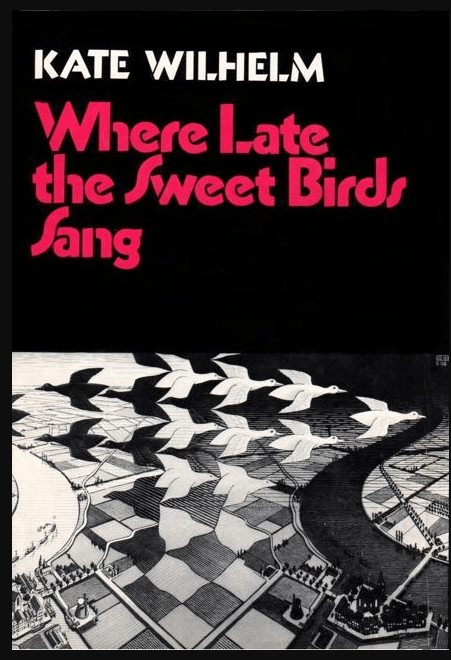
An aside. I bought this book as a deal through my normal means of coming by physical copies and had very little insight. Genuinely, I saw the cover, read the base synopsis, and thought it sounded interesting. I had no idea what really was in store for me. So as part one concludes with David setting off into the wild, I assumed we would come back to find him months or years later in the wild plotting against the clones. It truly through me through a loop that Wilhelm just picks right back up with the activities of the clones and how the compound is working. I waited for the whole length of the novel, or more or less the totality of part two, to see a re-emergence of this last straw of organic humanity to return, only for it to never happen. Now, that sounds frustrating, I think to most. I love the idea that there was no ambiguity and David was simply finished after part one, but I can see this being a bone of contention for a good score of average readers, so be advised David is finished after part one. Beginning part two, we find a clone, Molly, as our protagonist.
Molly is an interesting case as she is a first-generational clone but comes to defy the orders and ideology of the clones. Her segment, as she is solely confined to her portion of the novel, is the slow unwinding of the clone’s mental state into individuality. She is a great artist, but her work is seen as strange and outside of essential orthodoxy for the clones. Her art’s bizarre nature, or what is seen as peculiar to the clones, comes from psychological trauma brought on by an expedition of some of the clones into the wild. In addition to herself, another first-generation clone, Ben, is also mentally wounded from this outing. Over time, Molly is isolated in a house away from the compound, and in this house, Ben and she begin a relationship that results in the first organically born child in the community, Mark.
Mark being not another of the clones is a massive issue for the others, and Molly protecting him through isolation and Ben covering for them is immediately a hot-button issue. The trouble with Mark is how independent he is from the rest of the clones, his mind works differently, and he is not easily contained by the format of society. Through a long series of failed integration and the death of his mother, we see Mark change from a boy who fails to integrate into a man wanting to tear down the corruption he sees in the clone society.
Entering part three, Mark becomes our main focus. For a time, as stated, he tries to play well with others. He becomes, like David, skillful in the wild and seems to be the only one not affected by the wilderness nor comes back from it with any form of trauma. At first, this seems advantageous to the clones. They attempt to use him as a scout and later as someone to train young clones to navigate and survive in the wild. Though Mark gives his all to this idea, there seems to be, with so many of the clones, a fundamental inability to rival his natural comfort in the wild. However, the scientific minds of the community begin to devise a way to prevent the trauma and reinforce coming generations’ minds against the atrophy of the wild. It is about this time when Mark starts to slip from their grasp.
Between a few different factors, harassment, independence in the wild, the truth of his mother, as well as the general differences between himself from the clones, Mark begins to drift away. In a few short chapters, he plans a way to free himself from the society built only generations before by non-clones. Mark is a crafty young man who, being an outsider, easily sees through the weak points and finds anything exploitable about the structure of their society and compound.
I’ll spare you the conclusion as it is one that just feels so good to go over on your own. At least, that’s my take. I’m sure there are plenty of people who wouldn’t identify or side with Mark or Molly or even David, but I find myself easily on their side. As I stated, the story has much to do with conformity and societal versus individual goals and solutions. I’m easily driven towards stories like that, and I wish they were more the norm than ‘for the greater good’ heroes and stories, which are all a matter of perspective.
Of the author, I have very little to say. She wrote expansively in series of mystery and romance; however, Where Late the Sweet Birds Sang is her best-received novel. There is a great deal of science fiction novels she wrote, but of those, I know little more than a short story collection called The Infinity Box. The title novella had itself won the Nebula Award in 1992. I’ve read a good score of reviews for the Infinity Box, and in my next acquisition of sci-fi, it’s among those I’ve counted as necessary reads.
Typically I’d launch into some discussion of theme and plot points, but with this novel, I think a lot of it is self-evident on a single read. It is very an us versus them story and maybe one of the better ones I can quickly think of. Most individual against a society or group tales often come across like a lone maniac doing all they can to subvert norms or the singular humanized character against a homogenized mass of almost inhuman things. The lovely concept of clones truly humanized the antagonistic half, as they’re not devoid of humanity or feelings of their own. As a matter of fact, though we can see and sympathize with our protagonists, it’s not hard to also understand and identify with the clones in so many ways. It certainly is one of the best aspects of the novel to me as it doesn’t come across as forced or contrived but as a legitimate struggle between two entities that both have goals and ambitions, neither of which hold outlandish or bizarre ideals for said goals.
A link to the site I acquired my copy is posted below. It’s not very expensive, so consider picking up one for yourself.
 Trazor
Leave a comment